

Byline: By SK
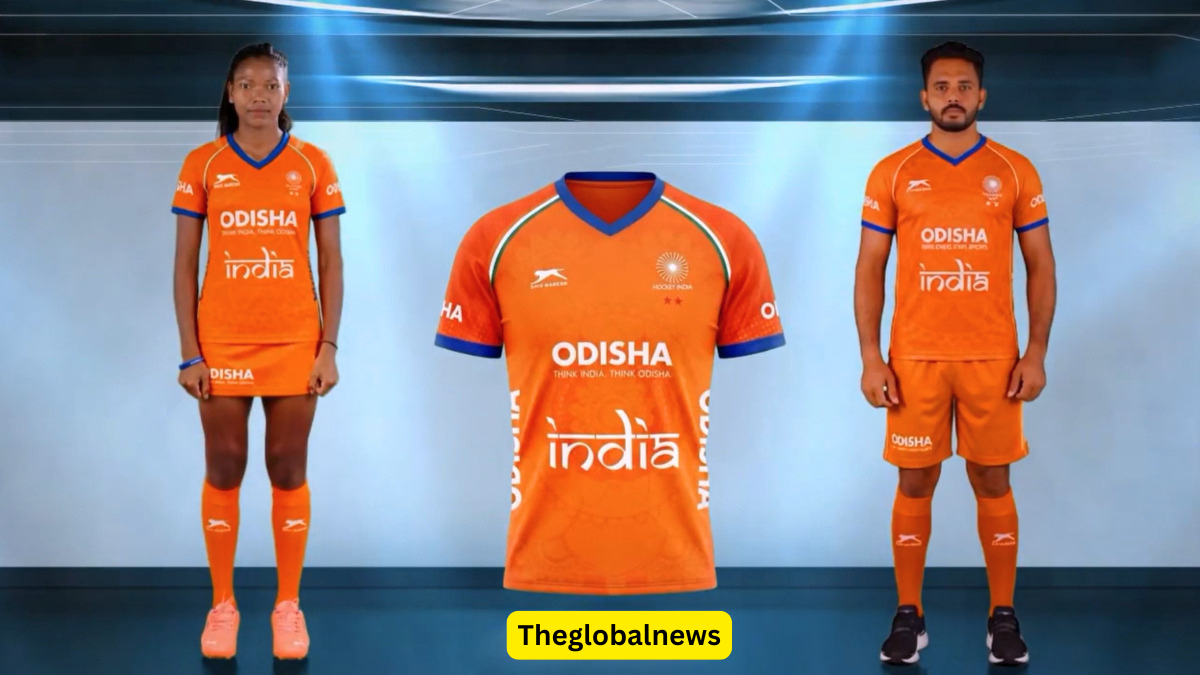
Indian sports fans were stunned when Hockey India officially unveiled the new playing kit for the senior men’s and women’s national teams. Instead of the iconic “Men in Blue” shade that has defined Indian sports teams for decades, the national hockey teams unveiled a primary uniform dominated by vibrant saffron and orange.

The new jersey features a rich saffron base accompanied by intricate cultural elements. The torso includes mandala-inspired geometric patterns celebrating traditional Indian heritage, while the chest graphic pays homage to the Sudarshan Chakra to symbolize strength and momentum. Dark navy blue accents, inspired by the Ashoka Chakra, frame the sides along with tricolour piping along the shoulders. Additionally, the name “INDIA” is prominently written across the front in a stylized Devanagari script to represent the country’s linguistic diversity.
While jersey re-designs are common in modern sports, changing the primary color of a national team from blue to orange immediately sparked intense debate across social media, among former legends, and within political circles.
Is the Orange Jersey Permanent or an Alternate Kit?
Hockey India confirmed that the new saffron and orange kit will serve as the primary playing jersey for both the men’s and women’s teams at the upcoming FIH Hockey World Cup. The secondary (alternate) kit for the tournament will be predominantly white.
However, Hockey India President Dilip Tirkey clarified that the jersey is not necessarily set in stone forever. Because the transition was introduced primarily based on direct requests from players and coaches, the federation remains open to reviewing the decision after the upcoming tournament.
If the playing squad or coaching staff feels uncomfortable with the color during high-stakes international competition, or if performance feedback indicates a desire to return to traditional colors, the governing body expressed flexibility to adjust or change the kit design in future cycles.
Why Was the Decision Made?
Contrary to initial speculation that the change was purely aesthetic or political, Hockey India explained that the primary motivation was technical and tactical visibility on the field.
In modern international hockey, the standard synthetic playing surface (turf) used in major tournaments is bright blue. Over recent years, coaches and players raised technical concerns that wearing a blue kit on a blue pitch creates a visual overlap during high-speed gameplay.
When players execute quick passes, scan peripheral vision, or track teammates in chaotic penalty corner situations, dark blue uniforms can blend in with the synthetic blue grass. This slight reduction in contrast can hinder instant decision-making on the pitch.
To solve this technical obstacle, the team management and players requested an alternate high-visibility color. The squad submitted two color suggestions to the federation: yellow and orange. After internal deliberation, Hockey India selected orange (saffron) because it fulfills the required technical contrast on blue turf while simultaneously representing one of the core colors of the Indian national flag.
Fan Reactions on Social Media
The departure from the iconic blue kit triggered passionate reactions across social platforms, dividing fans and sports commentators.
Many supporters welcomed the bold visual departure, praising the inclusion of the Devanagari script, mandala motifs, and bright, energetic colors that pop against the blue turf. Proponents argued that performance clarity should always take precedence over cosmetic tradition.
Conversely, several former players and fans expressed disappointment over losing the traditional blue identity. Former Indian hockey captain and Olympian Viren Rasquinha publicly questioned the logic on social media, calling the sudden departure embarrassing to the team’s historic legacy. Rasquinha noted that blue has been the identity of Indian sport for decades and questioned whether top international teams in other sports would ever switch their primary traditional colors.
Political figures also entered the discussion, with opposition leaders questioning the broader symbolism of changing national team identities. In response, Hockey India urged critics to focus on the technical necessity requested by the athletes rather than political interpretations.
Official Statement From the Hockey Federation
Addressing the controversy, Hockey India issued an official clarifying statement outlining the reasons behind the overhaul:
“The decision to change the uniform colour was based on support staff and players’ recommendations and detailed consultations with them. The primary consideration was technical. It was observed that the blue playing uniform tended to blend with the blue synthetic playing surface, which is now the standard colour of international hockey pitches. This visual similarity affected on-field clarity and visibility for the players.”
Hockey India President Dilip Tirkey reiterated that the federation prioritizes player comfort and competitive advantage above all else:
“On blue hockey turf, wearing blue jerseys created visual overlap during fast gameplay, reducing contrast and clarity. There was a specific request from players and coaches… Out of the two options requested by the squad (orange and yellow), orange was selected as it is represented in our national flag. If after the tournament the players feel otherwise, we can work again on improving the kit colour.”
History of India’s Hockey Jerseys
While blue has long been associated with Indian sport across cricket, hockey, and football, the national hockey team has actually experimented with non-blue kits multiple times throughout its storied history.
During the golden era of Indian hockey—when India dominated the Olympic Games with eight gold medals—the team frequently wore yellow, white, or navy blue variants depending on tournament requirements and opposing team colors.
In recent history, Hockey India has periodically modified the team’s visual identity:
- 2014 FIH Hockey World Cup: The national team wore a bright yellow primary jersey.
- 2018 FIH Hockey World Cup: India transitioned to a lighter sky-blue kit featuring distinct side paneling.
- 2021 & 2024 Olympic Games: India returned to deep royal blue jerseys with tricolour accents on the shoulders, securing back-to-back Olympic bronze medals in Tokyo and Paris.
The current transition to saffron represents another chapter in the evolution of the national team’s playing wear, adapting to modern pitch technology and visual performance demands.
Frequently Asked Questions (FAQ)
Why is India’s hockey jersey orange?
The primary reason for adopting an orange (saffron) jersey is technical visibility. International hockey matches are played on blue synthetic turf, and the previous blue jerseys blended into the pitch, reducing visual contrast for players during fast-paced gameplay. Orange was selected because it provides high contrast against blue turf and represents a key color of the Indian national flag.
Will India still wear the blue jersey?
For the upcoming World Cup campaign, the team will wear orange as its primary uniform and white as its alternate kit. However, Hockey India confirmed that blue could return in future tournaments if the players and coaching staff request a change after evaluating performance feedback.
When will the orange jersey debut?
The new saffron kit will make its official competitive debut at the FIH Hockey World Cup taking place in Belgium and the Netherlands.


- Mechanical Engineers in Oil & Gas: Why Aramco Experience, Site Skills and Driving Can Boost Your Career in 2026
- Aamir Khan and Sunny Deol Join Amitabh Bachchan for KBC 18 Premiere: Here’s What to Expect
- Sarfaraz Khan’s India Test Hopes Reopen After Sai Sudharsan’s Injury
- Mumbai Police Constable Guarding Salman Khan’s Residence Dies of Suspected Heart Attack
- Consumer Affairs Victoria Launches Bid to Shut Down Panda Mart Stores



Leave a Reply