

Byline: By SK
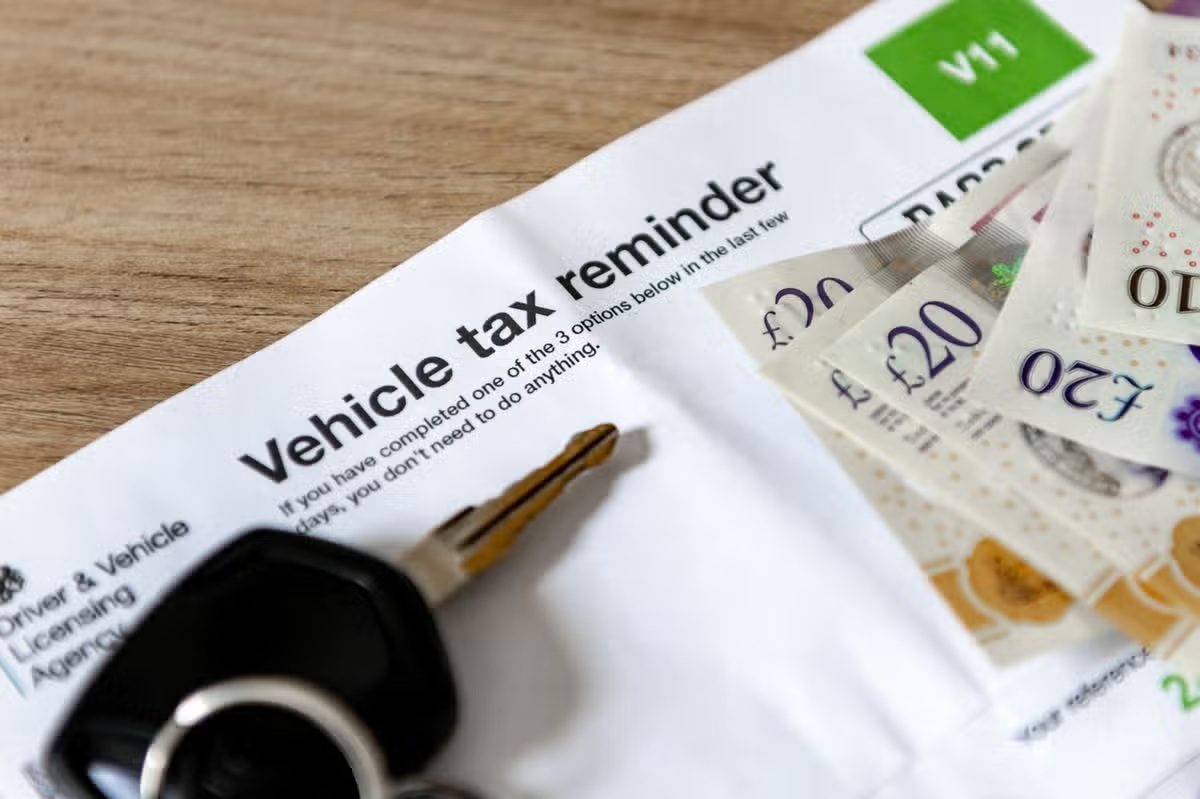
A minor administrative oversight involving a £20 annual vehicle tax bill recently led to an 86-year-old pensioner living with Parkinson’s disease being criminally convicted in a British court over an unpaid sum of just £3.34
The case—prosecuted by the Driver and Vehicle Licensing Agency (DVLA) through the controversial Single Justice Procedure (SJP)—has reignited fierce national debate over automated criminal enforcement, vulnerable citizens, and the lack of human oversight in administrative justice.
What Happened: The Human Story Behind the Court Case
The octogenarian driver, based on the outskirts of Newcastle, lives with Parkinson’s disease, while his 86-year-old wife suffers from Alzheimer’s disease. Due to their health conditions, the couple’s daughter manages their daily personal and financial welfare under a Lasting Power of Attorney (POA).
In January, the daughter was in the process of moving house. Because DVLA tax reminder letters were sent to her previous address, the annual £20 Vehicle Excise Duty (VED) payment for her father’s silver Ford Fiesta was inadvertently overlooked.
The car remained untaxed for a six-week window between February and mid-March. After discovering the oversight, the pensioner paid an £80 out-of-court administrative penalty, believing the matter was fully resolved.
However, because the vehicle was driven or kept on a public road during those six untaxed weeks, the DVLA initiated formal criminal proceedings for the uncollected duty amounting to £3.34.
Confused by the legal summons, the pensioner submitted a written guilty plea via the online system, outlining his health struggles and explaining that the car was already being sold as he was no longer capable of driving.
At Lincoln Magistrates’ Court, Magistrate Lynda Briggs accepted the guilty plea. Recognizing the extraordinary mitigating circumstances, the magistrate spared the pensioner additional fines, concluding the matter with an absolute discharge alongside a mandatory court order to pay £3.34 in compensation to the DVLA.
Official Context & Legal Procedures: How the SJP Works
To understand how a minor £3.34 debt escalates into a criminal conviction, one must look at the legal mechanics governing UK vehicle taxation and court operations.
The Role of the DVLA
Under the Vehicle Excise and Registration Act 1994, using or keeping an untaxed vehicle on a public road is a strict liability offense. The DVLA initiates automated enforcement proceedings based on computer registration databases, initially generating out-of-court fine notices before escalating unresolved cases to court action.
The Single Justice Procedure (SJP)
Introduced in 2015, the Single Justice Procedure allows a single magistrate, sitting with a legal advisor behind closed doors without the public or press present, to rule on summary (low-level) criminal offenses.
Under the design of the SJP:
- Defendants respond to charges by post or online.
- Prosecuting bodies (such as the DVLA, TV Licensing, or rail operators) do not routinely review written mitigation letters before the hearing takes place.
- Prosecutors are often unaware of compelling personal circumstances—such as severe illness or Power of Attorney complications—that might otherwise lead them to withdraw the case in the public interest.
The Wider Issue: Automated Enforcement and Vulnerable Citizens
This case is not an isolated incident. On the same day the Newcastle pensioner was convicted, the single magistrate in Lincoln processed 60 other DVLA cases, levying nearly £25,000 in fines, costs, and compensation. Government data reveals that nearly 2,000 people across England and Wales are prosecuted weekly through the SJP for unpaid vehicle tax.
Why the System Struggles with Human Context
- Automation Over Discretion: Automated systems flag discrepancies instantly, triggering legal notices without evaluating the vehicle owner’s age or health profile.
- Communication Gaps: When formal letters are delayed or sent to old addresses during family moves, drivers may only become aware of an issue after legal notices have been served.
- Misinterpretation of Fines: Many drivers assume that paying an initial out-of-court penalty resolves all liabilities, not realizing that back-dated duty for the untaxed period remains technically outstanding.
For elderly citizens dealing with neurodegenerative conditions like Parkinson’s or Alzheimer’s, navigating digital court forms and complex administrative jargon presents a severe hurdle.
Why It Matters for Ordinary Drivers
Could Similar Cases Happen to You?
Yes. Any driver who experiences a change of address, relies on a family member to manage correspondence, or misses a paper reminder due to mail redirection errors can inadvertently end up with an untaxed vehicle on record.
What Does This Mean for Motorists?
- Strict Liability Standard: Ignorance of an unpaid tax bill, even when caused by illness or moving home, is generally not recognized as a complete defense against a conviction under current statutory rules.
- Criminal Record Implications: A conviction through the SJP, even when resolved with an absolute discharge, formally records a guilty plea in court proceedings.
- Impending Reforms: The UK Government has been evaluating potential reforms to the Single Justice Procedure system to ensure public interest reviews occur before prosecution letters against vulnerable individuals proceed.
Suggested Visual Concepts for Website Publishing
- Featured Banner Graphic: A high-resolution graphic featuring a British registration mark plate, a DVLA warning notice overlay, and a gavel symbol to illustrate fast-track legal enforcement.
- Process Infographic: A step-by-step visual workflow displaying Unpaid Tax Notification -> Automated SJP Notice -> Online Mitigation Submission -> Closed-Door Magistrates Decision.
Key Takeaways: How to Avoid DVLA Tax Penalties
- Verify Your Tax Status Online: Do not rely solely on paper reminders. Check your vehicle’s tax and MOT status at any time for free on the official UK Government website using your vehicle registration number.
- Set Up Direct Debit Payments: Setting up an automated Direct Debit with the DVLA ensures annual or monthly tax renewals occur seamlessly without requiring manual action.
- Update V5C Log Book Addresses Immediately: Updating your driving licence address does not automatically update your vehicle’s V5C log book. Ensure both records reflect your current address to receive critical postal notices.
- Respond Promptly to Notices: If you receive a Single Justice Procedure notice, submit your mitigation immediately, and explicitly request that the prosecuting agency review the case under public interest guidelines.
Frequently Asked Questions (FAQ)
Why was the pensioner prosecuted over such a small amount?
The prosecution was initiated because strict liability rules apply to untaxed vehicles on public roads. Because the automated system processes cases based on unpaid periods rather than monetary value, a six-week untaxed window for a low-emission £20/year car resulted in a £3.34 back-tax balance that triggered legal proceedings.
How much is the penalty for unpaid vehicle tax in the UK?
The standard out-of-court penalty for an untaxed vehicle is £80, which can be reduced to £40 if paid within 28 days. However, if the matter proceeds to court through the Single Justice Procedure, magistrates can impose court fines of up to £1,000 alongside back-dated tax compensation orders and prosecution costs.
What happens if you miss a DVLA car tax payment?
If a tax payment is missed, the DVLA sends an administrative penalty notice. If left unaddressed or if back-dated tax remains unpaid, the case can escalate to debt collection enforcement or criminal prosecution via the Single Justice Procedure.
Can people with Parkinson’s or disabilities receive car tax exemptions?
Yes. Drivers who receive specific disability benefits—such as the higher rate mobility component of Disability Living Allowance (DLA) or Personal Independence Payment (PIP)—can apply for a 100% vehicle tax exemption. A 50% reduction is also available for those receiving the PIP standard rate mobility component. However, the exemption must be formally registered with the DVLA; diagnosis alone does not automatically exempt a vehicle.


- Mechanical Engineers in Oil & Gas: Why Aramco Experience, Site Skills and Driving Can Boost Your Career in 2026
- Aamir Khan and Sunny Deol Join Amitabh Bachchan for KBC 18 Premiere: Here’s What to Expect
- Sarfaraz Khan’s India Test Hopes Reopen After Sai Sudharsan’s Injury
- Mumbai Police Constable Guarding Salman Khan’s Residence Dies of Suspected Heart Attack
- Consumer Affairs Victoria Launches Bid to Shut Down Panda Mart Stores











Leave a Reply